Celestial Mechanics 101

What Is a Barycenter?

The concept your science teacher simplified — and why the full picture is essential to understanding the Iasoberg™ Technology.

The Definition

Barycenter

A barycenter is the term used to describe the center of mass of two or more celestial bodies — i.e., stars and planets, and/or a planet and its moon(s). Rather than one body orbiting another, all bodies in a gravitational system actually orbit their shared barycenter. The solar system barycenter and the Earth-Moon system barycenter are both described on this page.

Earth Doesn't Actually Orbit the Sun?

You were taught that Earth and other planets in our solar system orbit the Sun, and that our solar system orbits the center of the Milky Way. Did your science teacher have it wrong? Is everything you've learned about physics and gravity wrong?

For all practical purposes, what you were taught wasn't entirely wrong. Although the Earth does generally orbit the Sun, in the strictest sense, it doesn't. The Sun and all other planets each have their own gravitational force which interacts with and pulls on one another. The result of this phenomenon is that everything in an orbital system — like our solar system — orbits the center of mass of the system. This 'center of mass' of the solar system is called the solar system barycenter. The Earth, the Sun, and everything else in our solar system orbit this barycenter — not the Sun.
The Key Insight

In our solar system, the Earth, the Sun, and every other object all orbit a single shared point — the solar system barycenter. The Sun is close to that point most of the time, which is why we simplify it as "orbiting the Sun," but the two are not the same thing.

Where Is the Solar System Barycenter?

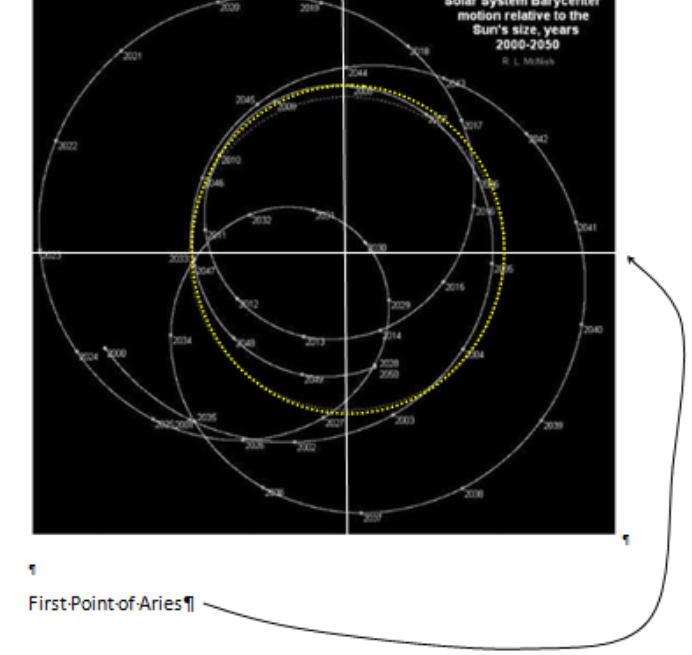
The diagram below displays the motion of the solar barycenter with respect to the center of the Sun (shown as a yellow dotted line circle). A coordinate system (x-y axis = white lines) is centered at the center of the Sun. The First Point of Aries — 0 degrees celestial longitude — is at the far right of the horizontal axis.

In a single-star system like ours, most of the time (but not always), the solar barycenter is located somewhere within the star itself — in our case, within the Sun. However, most barycenters continuously change as massive objects like planets orbit a star. If an unusual alignment happens where a large percentage of mass is on one side of the star, the barycenter can exist outside of the star's radius entirely.

In cases of two-star systems, the barycenter will always be located between the two stars, and if the stars aren't of the same mass, the barycenter will be closer to the heavier one. So the solar system barycenter and the Sun's location are dependent on the motion of the planets and other massive objects in the solar system.

Solar System Barycenter chart showing motion of barycenter relative to center of Sun

Solar Barycenter Chart courtesy of R.L. McNish, Calgary Centre of the Royal Astronomical Society of Canada.
The yellow dotted circle marks the Sun's position. White lines are the x-y coordinate axes centered on the Sun's center. First Point of Aries (0° celestial longitude) is at far right.

Where Is the Earth-Moon System Barycenter?

Given the above information regarding the solar system barycenter, it follows that the Moon doesn't revolve around the mass center of the Earth — it revolves around the Earth-Moon System barycenter. The Earth-Moon System barycenter is on the axis between the center of masses of the Earth and Moon.

The Moon is approximately 1/82 of the mass of the Earth, so this barycenter is about 3,000 miles (4,800 km) from the center of the Earth, along the axis between them — at an average Earth-Moon distance of 240,000 miles (380,000 km). Crucially, the barycenter of the Earth-Moon System is always within the Earth, never outside it.

The distance to the Moon also varies by about 30,000 miles (50,000 km), so the location of this barycenter within the Earth will vary about 380 miles (600 km) from a point 3,000 miles (4,800 km) from Earth's center, during one revolution of the Moon in 29 days.

~1/82
Moon-to-Earth Mass Ratio
Moon's mass relative to Earth
3,000 mi
Distance from Earth's Center
4,800 km along the Earth-Moon axis — always inside the Earth
~380 mi
Barycenter Variation
~600 km range of movement over the 29-day lunar cycle
Connection to the Iasoberg™ Technology

The Barycenter & Anti-Barycenter as Focal Points

The Earth-Moon System barycenter and another point — the anti-barycenter (located an equal distance from the center of the Earth along the Earth-Moon axis, in the opposite direction) — are two points at which 4 of the Iasoberg™ bands (2 bands per point) are focused.

These two continuously moving points, driven by the Moon's 29-day revolution and its varying orbital distance, are central to how the Iasoberg™ Technology identifies and maps gravitational force anomalies at specific surface locations on Earth. The barycenter is not static — it moves, and so do the Iasoberg™ bands focused upon it.

Solar System Barycenter

Definition: Center of mass of the entire solar system — the point around which the Sun, Earth, and all planets orbit.

Location: Usually within the Sun, but can move outside the Sun's radius during unusual planetary alignments.

Movement: Continuously shifting as the giant planets (especially Jupiter and Saturn) move through their orbits.

Significance: The true center of the solar system — not the Sun itself.

Earth-Moon System Barycenter

Definition: Center of mass of the Earth-Moon system — the true point around which both orbit.

Location: Always inside the Earth, approximately 3,000 miles (4,800 km) from Earth's center.

Movement: Varies ~380 miles (600 km) over each 29-day lunar cycle due to the Moon's elliptical orbit.

Significance: Along with the anti-barycenter, it is a focal point for 4 Iasoberg™ bands — making it central to the Technology's predictions.

The Allais Effect → Basic Theory Advanced Theory
← Previous: Overview You are here: Barycenter Next: Basic Theory  →