The People Behind the Technology
Two brothers from Northern Minnesota — one a decorated IBM engineer, one a University of Minnesota graduate with fifty years of research into gravitational anomalies — whose collaboration produced the Iasoberg™ Technology.
Founder & Creator of the Iasoberg™ Technology
University of Minnesota · Australia-based since 1969
Ed Oberg established iasoberg.com to facilitate and promote research into the Allais Effect and to distribute the findings of his work. He graduated from the University of Minnesota with a Bachelor of Mechanical Engineering and Industrial Engineering, and has had an eclectic career as a professional engineer and project manager at Honeywell and Control Data in the USA, and at private companies and the National Occupational Health and Safety Commission in Australia.
He migrated to Australia in 1969 and has lived there since. In 1974 he developed a special interest in celestial mechanics, which led him to undertake research into the area of gravitational anomalies. Over the following decades, this work resulted in the development of the Iasoberg™ Technology.
Ed established an Internet Yahoo Group which at its peak comprised approximately 180 members who discussed issues related to gravitational anomalies. He has continued to host the Facebook page promoting discussion and analysis of the Iasoberg™ phenomenon, and has been posting in Bruce Katz's global site for several years.
Software Architect & Technical Co-Developer
1944 – 2019
Bill and his brother Ed were born in the USA and grew up in Northern Minnesota. In his school years, Bill was always the brightest bulb in the box. Following high school, he found a real part of himself in the Air Force — where, recognising his tremendous intellect, they trained him in the most advanced systems they had at the time: computers, and programming the trajectories and targets of the USA's ICBMs.
After his service commitment, Bill took a tech and sales position at IBM and, due to his skills, intellect, work ethic and creativity, rose to become one of only five Senior Engineers when he retired in 2004.
In 2007, Bill began assisting Ed with developing the software to automate the outputs of the Iasoberg™ Technology algorithms. He also automated the display of those outputs on various Internet mobile devices and mapping applications and platforms. He continued to make significant contributions to the project — and to the world — throughout his life.
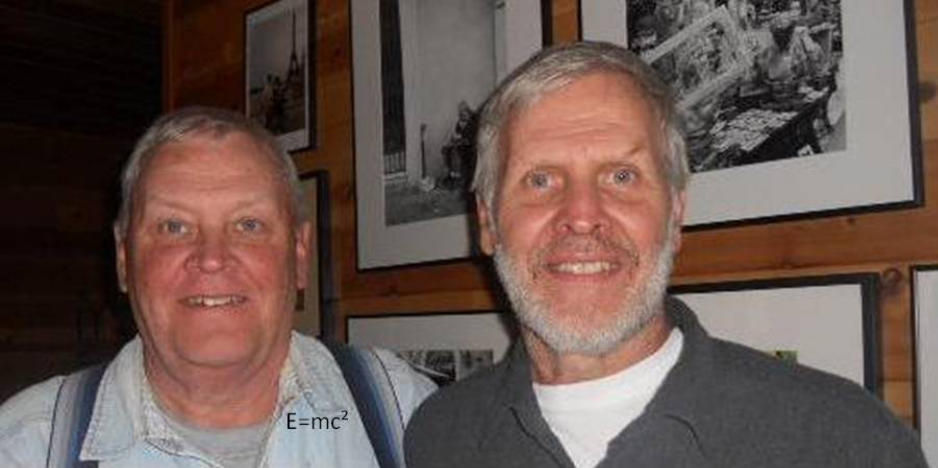
Chief Technologist, Iasoberg™ Technology
University of Minnesota · St. Paul, Minnesota, USA
Larry Oberg has proved a most extraordinary asset to the generation, development, and production of the Iasoberg™ Technology's information, data, and images. He linked up with Ed and his late brother Bill during the initial stages of the Technology's development and has since become a major contributor to all the technical issues and matters that support it.
Larry is expert across all the computer hardware, software applications, and programs used by the Iasoberg™ Technology team. He introduced and trained the team on two significant applications — Scribus and QGIS — that are now central to the Technology's workflow.
Larry's knowledge of graphics in particular has enabled the Technology to render NOAA/SPC graphics into a more user-friendly, easily understood format. These refined graphics are currently used in the Iasoberg™ Technology's potential severe-weather day frames.
Ed hosts the official Iasoberg™ Model group on Facebook, which promotes ongoing discussion and analysis of the Iasoberg™ phenomenon among interested researchers and subscribers worldwide.
Ed has been an active participant in Bruce Katz's global gravitational anomalies discussion group for several years, contributing ongoing analysis and Technology updates to a broad international audience.
Ed's original Internet Yahoo Group at its peak brought together approximately 180 members for discussion of gravitational anomaly research — one of the earliest online communities dedicated to this field.
Updates, commentary, and findings are posted regularly at the Iasoberg WordPress blog, providing an accessible record of the Technology's ongoing development.